
What You’ll Learn
- Why ‘salesy’ affiliate content underperforms
- The structure that actually converts
- Writing an honest, useful product review
- Where disclosure belongs in the content
- Common phrasing mistakes that hurt trust
The affiliate content that converts best rarely reads like an ad — it reads like a knowledgeable friend giving an honest opinion. This guide covers the structure and tone that builds enough trust to move a reader from ‘just browsing’ to ‘ready to click.’
Why ‘Salesy’ Affiliate Content Underperforms
Readers researching a purchase have usually already seen dozens of generic, superlative-heavy reviews (‘this is the BEST product ever!!’). Content that leads with genuine tradeoffs — what a product does well and where it falls short — reads as more credible and, counterintuitively, tends to convert better than uniformly glowing copy.
The Structure That Actually Converts
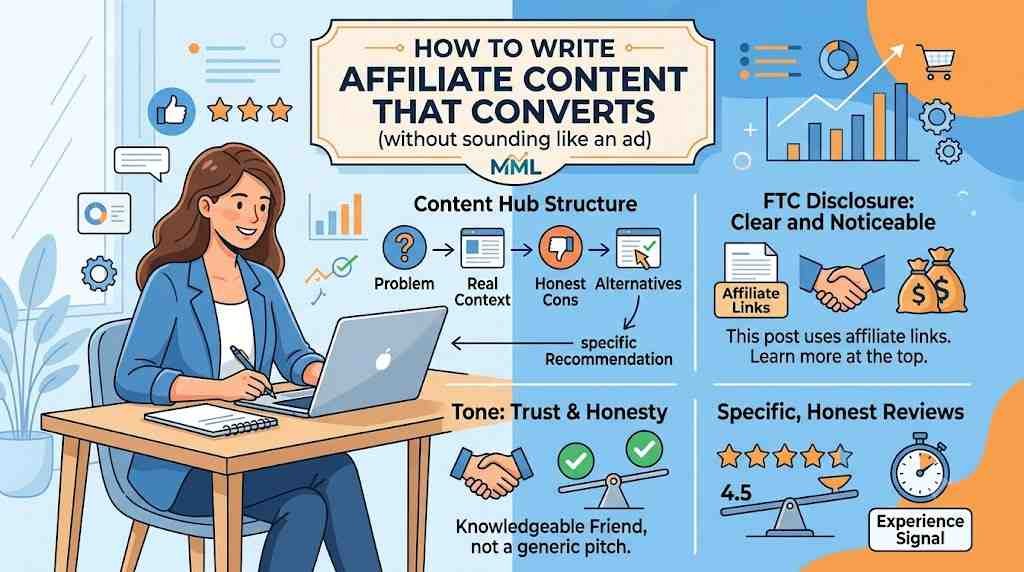
- Open with the reader’s actual problem, not the product name — show you understand what they’re trying to solve.
- Give real context on how you evaluated it — used it yourself, compared it against alternatives, or synthesized detailed research — this is core to EEAT’s ‘Experience’ signal.
- State pros and at least one honest con — a review with zero downsides reads as inauthentic to most readers.
- Compare against 1–2 alternatives so the reader feels they’ve seen the landscape, not just one pitch.
- Close with a specific recommendation tied to a type of reader (‘best for beginners’ vs. ‘best for heavy daily use’) rather than a single blanket verdict.
Writing an Honest, Useful Product Review
Specificity beats adjectives. ‘The battery lasted 6 hours of continuous use in my test’ is more persuasive and more trustworthy than ‘amazing battery life.’ Where you haven’t personally tested a product, be transparent that the review is based on synthesized research and specifications rather than implying hands-on use you didn’t have — Google’s guidance and reader trust both depend on this honesty.
Where Disclosure Belongs in the Content
FTC guidance requires the affiliate relationship be disclosed clearly and prominently, before the reader reaches the first affiliate link — not just in a footer or a separate policy page. A short, plain-language line near the top of the post (not legal jargon) satisfies this while keeping the content readable.
Common Phrasing Mistakes That Hurt Trust
- Overusing urgency language (‘buy now before it’s gone!’) on evergreen products with no real scarcity.
- Claiming personal use of a product you only researched — this is both an FTC and a trust issue if it comes out.
- Burying the one honest con so deep in the post that it reads as an afterthought rather than genuine balance.
Frequently Asked Questions
Does mentioning downsides hurt conversions?
Generally no — a review with at least one honest limitation tends to be perceived as more credible, which often improves conversion rather than hurting it.
Can I write a review of a product I haven’t personally used?
Yes, but you must be transparent about that — base it on specifications, other verified reviews, and clear reasoning rather than implying first-hand use you didn’t have.
How prominent does the affiliate disclosure need to be?
It needs to be clear and noticeable before the reader encounters the first affiliate link — a short, plain sentence near the top of the article is the standard approach.
Ready to apply this to your next post?
Revisit our Affiliate Marketing for Beginners guide for the full campaign framework this fits into.