

Most blogging advice on the internet was written for a different era. It talks about “following your passion,” picking any topic you love, and waiting for traffic to magically arrive. That approach worked in 2012. In 2026, it leads to abandoned blogs and wasted months.
This guide is different. It is written for the current reality — where Google is smarter, competition is higher, and the bloggers earning real money are the ones who treat their blog like a business from day one, not an afterthought.
If you follow every step in this guide, you will have a properly set up, monetisation-ready blog by the end of this week. More importantly, you will understand exactly what it takes to turn that blog into consistent income over the next 12 months.
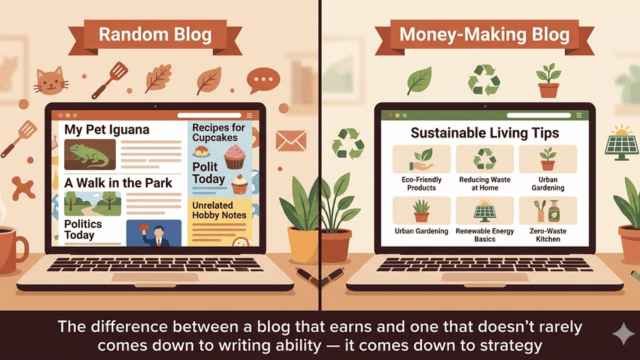
Table of Contents
- Can You Still Make Money Blogging in 2026?
- Choose a Profitable Niche (The Right Way)
- Pick Your Blogging Platform
- Get Your Domain and Hosting
- Set Up and Design Your Blog
- Plan Your Content Strategy
- Write Blog Posts That Rank on Google
- Drive Traffic to Your Blog
- Monetise Your Blog
- Mistakes That Kill New Blogs
- Realistic Timeline and Income Expectations
- Frequently Asked Questions
Can You Still Make Money Blogging in 2026?
Yes — but not the way most people try.
The bloggers struggling in 2026 are the ones still using outdated tactics: thin content, keyword stuffing, generic advice, and copy-paste affiliate reviews. Google has become increasingly effective at identifying and deprioritising that kind of content.
The bloggers thriving in 2026 are doing something different. They pick a focused niche, publish genuinely useful content, build topical authority over time, and monetise through multiple streams — affiliate marketing, display ads, digital products, and email. Their blogs are not just collections of articles. They are media assets that earn around the clock.
The opportunity is very much alive. According to multiple industry reports, the blogging and content publishing market continues to grow, with over 600 million active blogs online and advertisers spending more than ever on content-driven channels. The question is not whether blogging still works — it is whether you are willing to do it properly.
The honest reality: A well-built blog in a focused niche, updated consistently for 12–18 months, can generate $1,000–$5,000 per month passively. But it takes real effort upfront, and the results are rarely visible in the first few months.
Step 1 — Choose a Profitable Niche (The Right Way)
Your niche is the single most important decision you will make as a blogger. Get it right and everything else becomes easier. Get it wrong and no amount of hard work will save the blog.
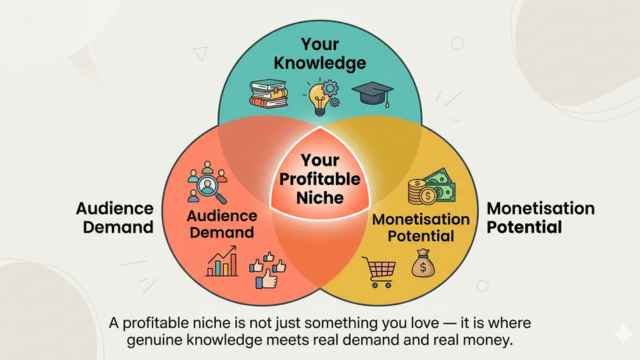
A profitable niche sits at the intersection of three things:
Audience demand — People are actively searching for information in this space. There is consistent, measurable search volume around the topic.
Monetisation potential — Products, services, or affiliate programs exist that you can promote. The audience has demonstrated willingness to spend money on solutions.
Your knowledge or genuine interest — You can write about this topic for 2–3 years without burning out. You do not need to be the world’s leading expert, but you need enough genuine knowledge to create content that is more useful than what already exists.
How to validate your niche before committing:
Search your main topic on Google and look at the results. If the first page is dominated by massive authority sites like WebMD, Forbes, or Wikipedia for every query, that is a sign you need to go narrower. Look for gaps — questions being asked in forums, on Reddit, or in YouTube comments that are not being answered well by existing content.
Use a free tool like Google Trends to check whether interest in your topic is growing, stable, or declining. A growing trend is obviously ideal. A stable trend is acceptable. A declining trend is a warning sign.
Examples of profitable niches in 2026:
Personal finance for freelancers. AI tools for small business owners. Home fitness for people over 40. Sustainable living on a budget. Digital products for teachers. Side hustles for college students. Each of these is specific enough to own, yet broad enough to have hundreds of article ideas and multiple monetisation paths.
Step 2 — Pick Your Blogging Platform
Your blogging platform is the software that powers your site. In 2026, the choice is clearer than ever.
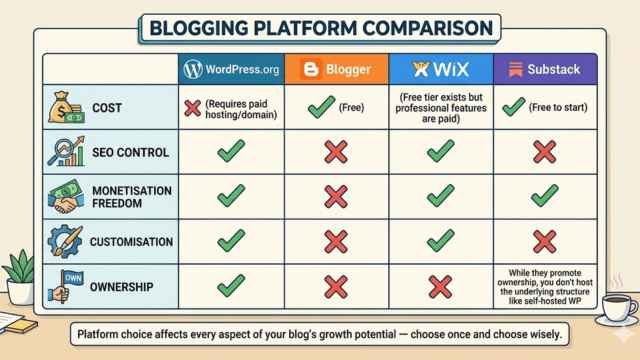
WordPress.org (Self-Hosted) — Recommended
WordPress.org powers over 43% of all websites on the internet. It is free, open-source, and gives you complete control over your site. You can install any theme, any plugin, and monetise however you choose with zero restrictions. This is the platform used by virtually every serious blogger and content business.
The only requirement is that you purchase your own domain and hosting — which we cover in the next step.
Blogger — For Absolute Beginners Only
Google’s free blogging platform. Zero cost, easy to set up, but severely limited in customisation, SEO capability, and monetisation options. Acceptable for testing ideas but not recommended for a serious income-generating blog.
Wix / Squarespace — Not Recommended for Bloggers
These website builders are excellent for portfolios and small business sites but are not built for content-heavy, SEO-focused blogs. They lack the plugin ecosystem and flexibility that WordPress provides.
Substack / Medium — For Audience Building, Not SEO
These newsletter and publishing platforms are excellent for building an engaged readership quickly but offer very limited SEO control. You also do not own your audience — the platform does. Use these as supplementary channels, not your primary blog.
Bottom line: Use WordPress.org. It is the industry standard for a reason. Every tool, tutorial, and resource you will ever need is built for it.
Step 3 — Get Your Domain and Hosting
Your domain is your blog’s address (yourblogname.com). Your hosting is the server where your blog actually lives. You need both.
Choosing Your Domain Name
Keep it short — ideally under 15 characters. Make it easy to spell and pronounce. Avoid hyphens and numbers. A .com extension is still the most trusted and most memorable. If possible, include a keyword related to your niche — but do not force it. A brandable, memorable name beats a keyword-stuffed one every time.
Take time with this decision. Changing your domain later is possible but creates SEO complications. Think of it as naming a business — because that is exactly what you are doing.
Choosing Your Hosting Provider
For a new blog, you do not need expensive enterprise hosting. A reliable shared hosting plan from a reputable provider is more than sufficient. Look for:
A guaranteed uptime of 99.9% or higher. Good customer support (live chat ideally). One-click WordPress installation. A free SSL certificate (the padlock in your browser that signals a secure site — Google requires this for ranking). A reasonable renewal price, not just a low introductory rate.
Reputable providers commonly used by bloggers include Bluehost, SiteGround, Hostinger, and Namecheap. Costs typically range from $2–$10 per month on introductory plans.
Step 4 — Set Up and Design Your Blog
Once WordPress is installed through your hosting provider’s control panel, your blog technically exists. Now you need to make it look credible, load fast, and function properly.
Install a Clean, Fast Theme
A theme controls the visual appearance of your blog. In 2026, site speed is a direct Google ranking factor — a slow theme can hurt your SEO before you publish a single post. Choose a lightweight theme built for performance.
Popular options among serious bloggers include Astra, GeneratePress, and Kadence — all of which are free, fast, and highly customisable. Avoid bloated premium themes loaded with features you will never use. Speed beats aesthetics every time.
Install Essential Plugins
Plugins extend WordPress functionality. You do not need dozens — you need the right ones. Start with these:
An SEO plugin (Rank Math or Yoast SEO) to optimise your posts for search. A caching plugin (W3 Total Cache or WP Super Cache) to improve site speed. An image compression plugin (Smush or ShortPixel) to keep load times fast. A security plugin (Wordfence) to protect your site. A backup plugin (UpdraftPlus) so you never lose your work.
Create Essential Pages
Before publishing your first post, create these pages: About (who you are and why your blog exists), Contact (a simple form for reader and brand inquiries), Privacy Policy (legally required in most countries for blogs that collect data or run ads), and Affiliate Disclosure (required if you promote affiliate products).
Step 5 — Plan Your Content Strategy
Here is where most new bloggers fail. They start writing whatever comes to mind, publish inconsistently, and wonder why they have no traffic after six months. A content strategy is not optional — it is the foundation of everything.
Start With Keyword Research
Keyword research tells you what your audience is actually searching for on Google. Instead of writing what you think people want to read, you write what you know they are already looking for.
For a new blog, focus exclusively on low-competition, long-tail keywords — specific phrases that are easier to rank for than broad, high-volume terms. “How to start a blog” has enormous competition. “How to start a food blog on a tight budget” is far more winnable for a new site.
Free tools for keyword research include Google Search Console (once your site has data), Google’s autocomplete suggestions, and the “People Also Ask” boxes in search results. Paid tools like Ahrefs and Semrush offer deeper data but are not necessary when starting out.
Build Topic Clusters, Not Random Posts
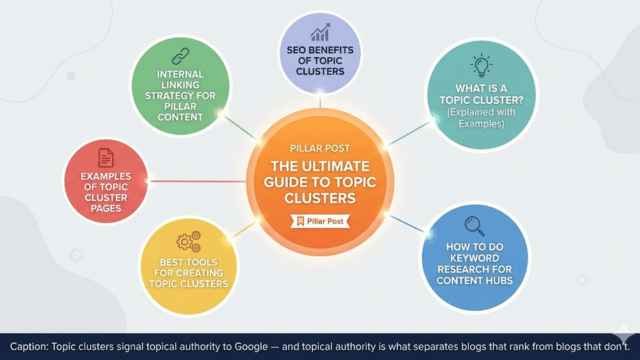
In 2026, Google rewards topical authority — the idea that your site covers a topic thoroughly and comprehensively rather than touching on random subjects. Instead of writing unrelated posts, build clusters: one main “pillar” article covering a broad topic in depth, supported by several related posts that each address a specific subtopic and link back to the pillar.
For example, a pillar post on “Affiliate Marketing for Beginners” could be supported by posts on “Best Affiliate Programs for Bloggers,” “How to Write Affiliate Product Reviews,” and “How to Add Affiliate Links in WordPress.” All link back to each other, signalling to Google that your site has genuine depth on this topic.
Set a Realistic Publishing Schedule
Consistency beats frequency. Two well-researched, thoroughly written posts per week will outperform five rushed ones every time. Set a schedule you can genuinely sustain and stick to it for at least six months before evaluating results.
Step 6 — Write Blog Posts That Rank on Google
Writing for SEO in 2026 is not about stuffing keywords into sentences. It is about creating the most genuinely useful, complete answer to the question your reader typed into Google. Here is the framework:
Match Search Intent First
Before writing a single word, understand why someone is searching for your keyword. Are they looking for information? A comparison? A step-by-step guide? A product recommendation? Google’s first page already shows you the answer — look at what type of content is ranking and match that format.
Structure Your Post for Skimmability
Most readers scan before they read. Use a clear H1 title, H2 section headings, and H3 subheadings to organise your content. Use short paragraphs — three to four sentences maximum. Use bullet points and numbered lists where information is genuinely list-like. Bold the most important phrases so scanners catch the key points.
Write a Compelling Introduction
Your introduction has one job: convince the reader that this article is worth their time. Acknowledge the problem they are trying to solve, hint at what they will gain by reading on, and get to the substance quickly. Do not start with “In today’s digital world…” That opener has been used ten million times and signals generic content immediately.
Include Internal Links
Link to other relevant posts on your own blog wherever it makes sense. Internal linking helps readers discover more of your content and helps Google understand the structure and hierarchy of your site. Every post you publish should link to at least two other posts and receive links from at least one other post.
End With a Clear Call to Action
Every post should end by telling the reader what to do next. Read another article. Join your email list. Download a resource. A reader who takes one more action on your site is significantly more valuable than one who reads and leaves.
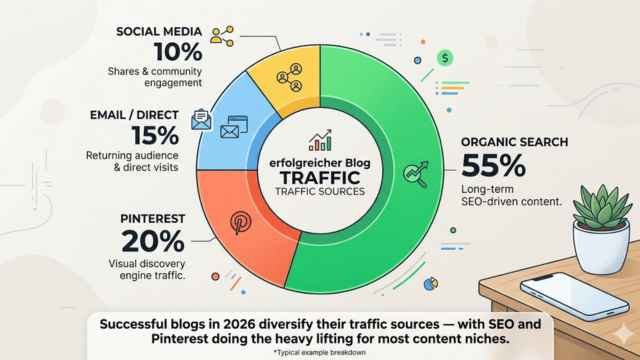
Step 7 — Drive Traffic to Your Blog
Publishing great content is necessary but not sufficient. You also need to actively build traffic, especially in the early months before Google fully recognises your site’s authority.
SEO — Your Long-Term Traffic Engine
Search engine optimisation is the process of making your content rank higher in Google results. It takes time — most new blogs see meaningful organic traffic after 6–12 months — but the payoff is enormous because SEO traffic is free, targeted, and consistent. Focus on: publishing keyword-targeted content regularly, earning backlinks from other reputable sites, improving site speed, and keeping your content updated and accurate.
Pinterest — The Fastest Free Traffic Source for Bloggers
Pinterest functions more like a search engine than a social media platform. A single well-designed pin linking to your blog post can drive traffic for months or even years. Pinterest works especially well for niches like personal finance, food, health, home, travel, and lifestyle. Create vertical pins (2:3 ratio) with clear headlines and post consistently — at least five pins per day is the recommended baseline for growth.
Email List — Your Most Valuable Asset
An email list is the only audience you truly own. Social platforms change algorithms. Google updates rankings. But your email subscribers stay with you. Start building your list from day one by offering a free resource (a checklist, guide, or template) in exchange for an email address. Even 500 engaged email subscribers can generate meaningful income through affiliate promotions and product launches.
Social Media — Supplementary, Not Primary
Pick one or two social platforms where your target audience spends time. Do not try to be everywhere. Share your blog content, engage genuinely in your niche community, and use social media to build awareness — but do not depend on it as your primary traffic source.
Step 8 — Monetise Your Blog
Here is the part everyone wants to get to quickly — and the part most new bloggers rush into too early. Monetisation works best when you have an audience that trusts you. That said, you should set up the foundations from day one, even before the traffic arrives.
Affiliate Marketing — Best for Beginners
Recommend products and services relevant to your niche through affiliate links. This is the fastest path to income for most new bloggers because it requires no product creation. Every product review, comparison post, or buyer’s guide you publish is a potential commission-generating asset. We covered this in depth in our previous guide on affiliate marketing.
Display Advertising — Passive but Requires Traffic
Networks like Google AdSense are open to new blogs and require no minimum traffic. However, earnings are very low at small traffic volumes — typically $2–$5 per 1,000 page views. Premium ad networks like Mediavine (50,000 sessions/month minimum) and Raptive (100,000 page views/month) pay significantly more and are worth targeting as your traffic grows.
Digital Products — Highest Profit Margins
Ebooks, templates, courses, and printables can be created once and sold indefinitely with near-zero overhead. A well-positioned $27 ebook in a focused niche can generate significant passive income once you have an audience. This is the most scalable monetisation model for an established blog.
Sponsored Content — Once You Have Authority
Brands pay bloggers to write posts featuring their products. Rates vary enormously — from $50 for a new blog to $5,000+ for an established authority site. Do not approach brands until you have a decent amount of traffic and a professional media kit.
Important: Disclose all affiliate links and sponsored posts clearly at the top of every relevant article. This is legally required in most countries and builds reader trust rather than destroying it.
Mistakes That Kill New Blogs
Publishing without keyword research. Writing posts nobody is searching for means writing into a void. Every post should target a specific keyword with measurable search demand.
Choosing an overly broad niche. Trying to cover everything means ranking for nothing. The more focused your niche, the faster you build authority.
Neglecting site speed. A blog that loads in more than three seconds loses a significant percentage of visitors before they even read a word. Speed is both a user experience issue and a direct Google ranking factor.
Comparing your month one to someone else’s year three. Most of the income screenshots you see online come from bloggers who have been building for years. Your timeline is your own. Comparison at the wrong stage kills motivation.
Giving up before month twelve. The vast majority of bloggers who quit do so within the first six months — right before the compounding effect of SEO begins to show. The bloggers who succeed are almost always the ones who simply kept going.
Realistic Timeline and Income Expectations
Months 1–3: Setup, first 20–30 posts published, zero or minimal traffic. This phase is entirely about building the foundation. Do not measure success by income — measure it by content output and consistency.
Months 4–6: Google begins indexing and ranking some of your content. Traffic starts arriving, typically 100–500 page views per month. First affiliate commissions may appear. Income: $0–$100/month.
Months 7–12: Traffic compounds meaningfully. Established posts begin climbing in rankings. Email list starts to grow. Income: $100–$1,000/month for a well-executed blog.
Year 2: Multiple traffic sources working together. Display ads become worthwhile. Affiliate income becomes consistent. Income: $1,000–$5,000/month.
Year 3+: Authority established. Sponsored content, digital products, and premium ad networks unlock. Income: $5,000–$20,000+/month for a well-monetised niche blog.
These figures represent realistic outcomes for bloggers who publish consistently (2–4 posts per week), conduct keyword research, and apply the monetisation strategies covered in this guide. Results vary based on niche competitiveness, content quality, and consistency.
The Bottom Line
Starting a blog in 2026 that makes money is not complicated — but it is also not as passive or effortless as most online content suggests. It requires a focused niche, a proper technical setup, consistent content creation, patient SEO work, and a monetisation strategy applied from day one.
The bloggers who succeed are not necessarily the best writers. They are the most consistent ones — the ones who show up week after week, publish content that genuinely helps their readers, and treat their blog as a long-term business rather than a short-term experiment.
You now have everything you need to start correctly. The next step is simply to begin.
Frequently Asked Questions
How much does it cost to start a blog in 2026? The bare minimum cost is a domain name ($10–$15/year) and web hosting ($2–$10/month). Total first-year cost is typically $35–$130 depending on the hosting plan you choose. You do not need to spend money on premium themes or paid tools when starting out — the free options available for WordPress are more than sufficient.
How many blog posts do I need before I start making money? There is no magic number, but most bloggers see their first meaningful traffic and income after publishing 30–50 well-optimised posts. Quantity matters less than quality and keyword targeting. Twenty excellent, well-researched posts consistently outperform fifty thin, generic ones.
Do I need technical skills to start a blog? No. Modern hosting providers offer one-click WordPress installation, and WordPress itself is designed for non-technical users. If you can use a word processor, you can run a WordPress blog. Basic SEO and site speed optimisation have a slight learning curve but are well-documented and straightforward to implement.
Which niche is most profitable for blogging in 2026? The most consistently profitable niches are personal finance, health and wellness, technology and software reviews, online business and marketing, and lifestyle/travel. However, profitability depends heavily on your ability to build authority in the niche. A focused, well-executed blog in a mid-tier niche will outperform a poorly executed blog in a “hot” niche every time.
How long does it take for a blog to rank on Google? New blogs typically begin seeing Google traffic between three to six months after launch, assuming consistent publishing and basic on-page SEO. Competitive keywords can take twelve months or longer to rank for. Focus on low-competition, long-tail keywords early in your blog’s life and build toward more competitive terms as your domain authority grows.
Can I blog anonymously without showing my face? Yes. Many successful blogs operate without a personal face attached to them. A brand identity (like MoneymakeLab) works perfectly well without a personal author. That said, adding an author bio and a real name — even without photos — adds credibility and can improve Google’s assessment of your site’s trustworthiness under its E-E-A-T guidelines (Experience, Expertise, Authoritativeness, Trustworthiness).
What is the biggest mistake new bloggers make? Publishing content without keyword research. Writing posts that nobody is actively searching for is the single fastest way to guarantee your blog gets no traffic regardless of writing quality. Every post you publish should be a deliberate answer to a question your target audience is actively asking on Google.
© 2026 MoneymakeLab.com · This post contains affiliate links. If you purchase through them, we may earn a small commission at no extra cost to you.