What You’ll Learn
- Why most freelance proposals get ignored
- The structure of a proposal that gets read
- Personalizing without spending an hour per proposal
- Pricing your proposal strategically
- A before/after example
- Follow-up etiquette that doesn’t feel pushy
Most freelance proposals fail before the client even finishes reading the first line, because they open with information the client already knows (restating the job post) instead of showing understanding of the actual problem. This guide covers the structure that consistently gets replies.
Why Most Freelance Proposals Get Ignored
Clients posting a job typically receive dozens of near-identical proposals within hours. Generic openers (‘I am a hardworking professional with 5 years of experience…’) signal a copy-pasted template and get skipped in seconds. The proposals that get read demonstrate, in the first two sentences, that you actually understood the specific problem in the posting.
The Structure of a Proposal That Gets Read
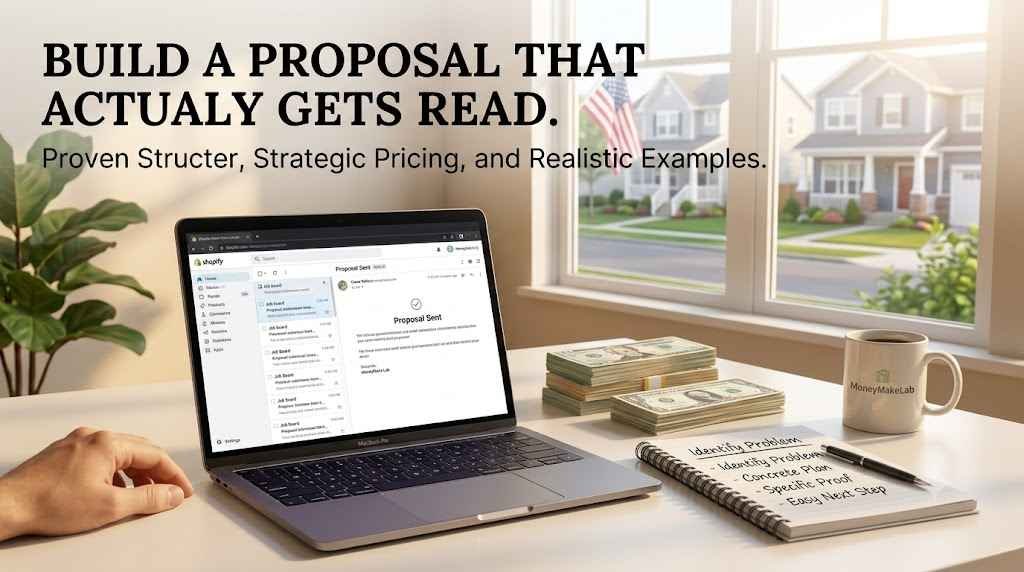
- Open by naming their specific problem in your own words — this proves you read the brief, not just the title.
- State your approach in 2–3 sentences — a concrete plan, not vague reassurance.
- Reference one relevant piece of proof — a sample, a similar past project, or a specific, believable result.
- End with a clear, low-friction next step — a specific question or a simple call-to-action, not just ‘let me know if interested.’
Personalizing Without Spending an Hour Per Proposal
Build a modular template with 2–3 interchangeable proof points and approach paragraphs for your core service types, then customize only the opening problem-statement and closing line per job. This keeps proposals fast to send while still avoiding the generic, obviously-templated feel that gets skipped.
Pricing Your Proposal Strategically
For early proposals with no reviews yet, pricing slightly below your target rate (not rock-bottom) reduces client risk perception enough to get a first reply, without signaling low quality. Once you have 5–10 reviews, gradually shift toward market-rate pricing rather than staying underpriced indefinitely.
A Before/After Example
Before: A generic opener claiming general experience and asking the client to review an attached portfolio, with no reference to the specific job.
After: An opener naming the client’s exact stated problem, followed by a specific 2-step plan to solve it, one relevant proof point, and a direct question that’s easy for the client to answer in one line.
Follow-Up Etiquette That Doesn’t Feel Pushy
If a client hasn’t responded within 3–5 days, a single brief follow-up referencing something specific from the original brief (not just ‘checking in’) is generally well received. Beyond one follow-up, further messages typically hurt more than help — move on and apply that time to new proposals instead.
Frequently Asked Questions
How long should a freelance proposal be?
Generally 100–200 words — long enough to show real understanding and a concrete approach, short enough that a busy client reads the whole thing.
Should I attach samples to every proposal?
Yes when relevant — one directly relevant sample is more persuasive than a full portfolio link the client has to click through and evaluate themselves.
Is it okay to ask questions in a proposal instead of just pitching?
Yes — a specific, relevant question can signal genuine engagement with the brief and often prompts a reply faster than a purely one-way pitch.
Need a portfolio to back up your proposals?
Our freelancing beginner’s guide covers how to build sample work fast, even with zero client history.