What Is Affiliate Marketing, Exactly?
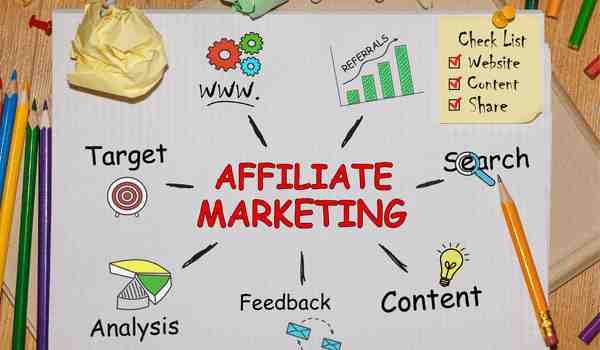
Affiliate marketing is a performance-based income model where you earn a commission by promoting another company’s product or service. You do not create the product, handle customer service, or manage inventory. Your job is simply to connect the right buyer with the right product — and when they purchase, you get paid.
Here is the simplest way to think about it: you are a referral partner, not a reseller. You recommend. They buy. You earn a percentage of the sale.
Affiliate marketing = earning a commission by referring customers to another company’s product or service through your unique tracking link.
The term “affiliate” simply means you are officially associated with a brand’s sales program. Every major company from Amazon to software startups runs some version of this. In fact, the global affiliate marketing industry crossed $17 billion in 2026 — and it keeps growing every year because companies get measurable results and affiliates earn without the overhead of running a business.
How Does Affiliate Marketing Actually Work?
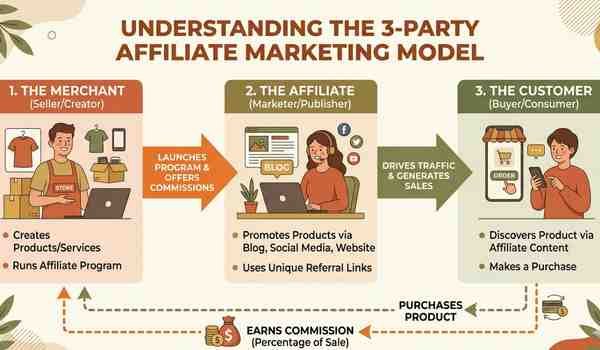
The process involves three key players. Understanding each one makes the entire model click.
The Three Parties in Every Affiliate Transaction
| Party | Who They Are | What They Do | What They Get |
|---|---|---|---|
| The Merchant | Amazon, Bluehost, a course creator | Creates the product or service | More sales without paid ads |
| The Affiliate | You — a blogger, YouTuber, or creator | Promotes the product to an audience | A commission per sale or lead |
| The Customer | Someone searching for a solution | Clicks your link and makes a purchase | The product they wanted |
There is also a fourth element — the affiliate network (like ShareASale or CJ Affiliate) — which acts as a marketplace connecting affiliates to dozens of merchant programs in one place. Not all programs use networks; many run their own in-house programs.
The Role of the Tracking Link
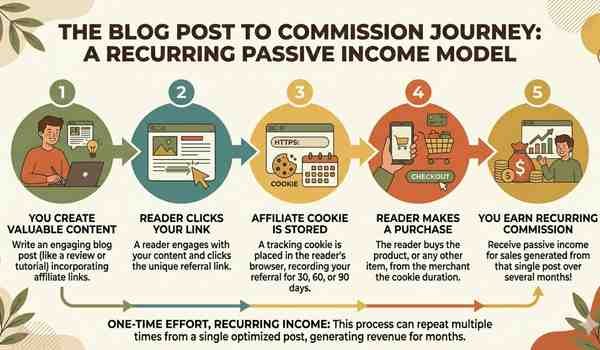
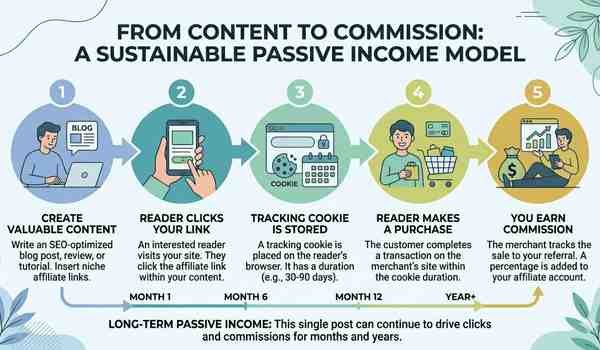
The entire affiliate system runs on a unique tracking link assigned specifically to you. When someone joins your affiliate program, they receive a URL like this:
https://example.com/product?ref=yourname
When a visitor clicks this link, a small text file called a cookie is stored in their browser. If they purchase within the cookie window (typically 24 hours to 90 days depending on the program), you earn the commission — even if they closed the tab and came back later.
Your affiliate link is your asset. Every click it receives is a potential commission. The quality and relevance of your content determines how many qualified clicks your link gets.
Types of Affiliate Marketing (And Which One is Right for You)
Not all affiliate marketing looks the same. In 2026, practitioners broadly operate in three modes, each requiring a different level of trust and audience investment.
1. Unattached Affiliate Marketing
You have no personal connection to the product. You run paid ads or create content purely to drive clicks. No authority is required, but it is also the least sustainable — and the hardest to scale profitably without a budget for ads.
2. Related Affiliate Marketing
You have an audience in a relevant niche but do not necessarily use every product you promote. A fitness blogger recommending a protein brand they have heard of, for instance. Trust is moderate — audiences are often forgiving if the recommendation makes logical sense.
3. Involved Affiliate Marketing
You personally use and believe in the products you promote. This is the gold standard in 2026. When your audience knows you have skin in the game, conversion rates are dramatically higher. This is the model that builds long-term income.
“The days of throwing affiliate links at cold traffic are numbered. In 2026, the affiliates winning are the ones their audiences actually trust — and trust is only earned through genuine experience with what you recommend.”
— MoneymakeLab Editorial Analysis
How Do Affiliates Get Paid? Commission Models Explained
Understanding commission structures helps you choose programs strategically. Here are the main payment models:
- Pay Per Sale (PPS): You earn a percentage of the sale price. Most common model. Amazon pays 1–10% depending on category. Software companies often pay 20–50%.
- Pay Per Lead (PPL): You earn when someone completes an action — filling a form, starting a free trial. Common in finance, insurance, and SaaS niches.
- Pay Per Click (PPC): You earn per click on your link, regardless of purchase. Rare and typically very low payout per click.
- Recurring Commission: You earn every month a customer stays subscribed. This is the holy grail — one referral can pay you for years. Common in SaaS and membership programs.
Short cookie durations (24 hours) mean you lose credit if the buyer takes their time. Always check cookie length before joining a program. Aim for 30–90 day cookies wherever possible.
How to Start Affiliate Marketing: 6 Steps for Beginners
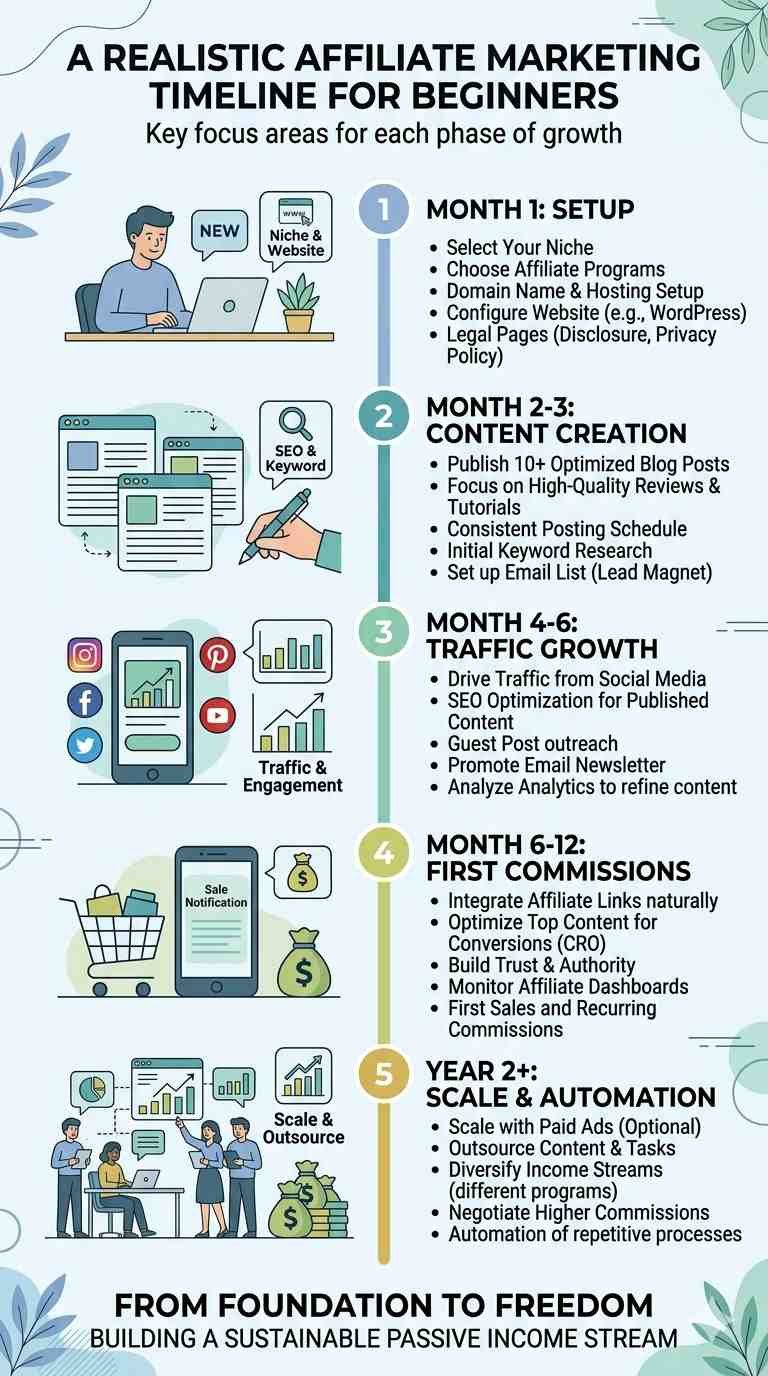
Starting does not require a large budget, technical expertise, or an existing audience. What it does require is a clear starting point and the patience to build. Here is the exact sequence to follow:
-
01
Choose a Niche You Can Own
Pick a topic narrow enough to build authority in, but broad enough to have a real audience and multiple products to promote. “Health and wellness” is too broad. “Gut health for busy professionals” is a niche. The more specific you are, the easier it is to rank on Google and earn trust.
-
02
Pick Your Content Platform
A blog is the most SEO-friendly long-term channel. A YouTube channel works well for product reviews. Pinterest drives strong traffic in visual niches. Email newsletters build the deepest trust. Most successful affiliates start with one platform and expand later.
-
03
Join 2–3 Affiliate Programs Relevant to Your Niche
Do not sign up for 20 programs at once. Start with Amazon Associates (easy approval, massive product range) plus one or two niche-specific programs with higher commissions. Quality over quantity always wins.
-
04
Create Content That Answers Real Questions
Write or record content that genuinely helps your audience make informed decisions. Product comparisons, buyer’s guides, how-to tutorials, and honest reviews consistently outperform generic “top 10” lists. Every piece of content should serve the reader first, and the affiliate link second.
-
05
Drive Consistent Traffic
No traffic = no commissions. Use SEO to attract search traffic (takes 3–6 months to build), social media for faster exposure, and email to retain your best audience members. Diversify your traffic sources so no single algorithm change can wipe out your income.
-
06
Track, Optimise, and Scale
Use your affiliate dashboard and Google Search Console to understand which content drives clicks and which drives conversions. Double down on what works. Update old content regularly — Google rewards freshness, and updated posts often outperform new ones.
Best Affiliate Programs for Beginners in 2026
With thousands of programs available, narrowing down your starting options is essential. Here are reliable choices that work well for new affiliates:
| Program | Commission | Cookie | Best For | Beginner Friendly |
|---|---|---|---|---|
| Amazon Associates | 1–10% | 24 hours | Physical products, any niche | ✔ Yes |
| ShareASale | Varies (5–50%) | 30–90 days | Hundreds of niche brands | ✔ Yes |
| CJ Affiliate | Varies | 30–45 days | Big brand partnerships | ✔ Moderate |
| Bluehost | $65–$100/sale | 90 days | Blogging / web hosting niche | ✔ Yes |
| ConvertKit | 30% recurring | 30 days | Creator / email marketing niche | ✔ Yes |
| ClickBank | 50–75% | 60 days | Info products, health, finance | ✔ Yes |
5 Mistakes Beginners Make (That Kill Their Results)
After studying hundreds of beginner affiliate journeys, the same mistakes appear again and again. Knowing them in advance is worth more than any tactical tip:
- Promoting too many products too early. When everything is a recommendation, nothing is. Focus on a small, curated set of genuinely useful products — this builds trust and improves conversion rates.
- Ignoring SEO from day one. SEO compounds. Every post you optimise today can earn commissions for years. Ignoring it means you’ll always depend on paid traffic or algorithms you don’t control.
- Not disclosing affiliate relationships. This is not optional — it is legally required in most countries (including the US under FTC guidelines and India under ASCI rules). Always disclose clearly. It also builds trust.
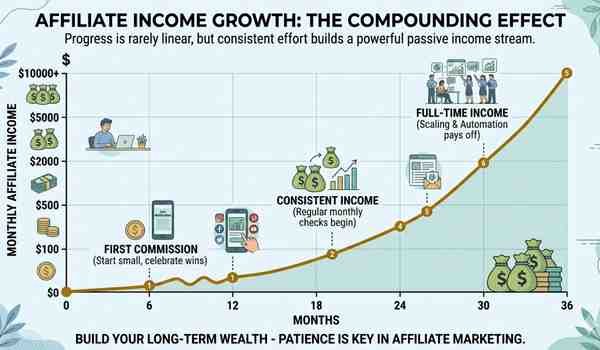
- Expecting fast results and quitting too early. Most affiliate sites take 6–12 months to generate meaningful traffic. The ones that succeed are the ones that keep publishing consistently through the slow early phase.
- Choosing a niche based only on commissions. High-commission niches with no personal relevance are hard to sustain. Write about what you genuinely know or care about — the depth and authenticity shows, and Google rewards it.
Realistic Income Expectations for 2026
Let us be direct about income potential, because this topic attracts more exaggerated claims than almost any other in online business.
| Experience Level | Timeframe | Realistic Monthly Income |
|---|---|---|
| Complete Beginner | Months 1–3 | $0 – $50 (learning phase) |
| Building Momentum | Months 4–8 | $50 – $500 |
| Established | Year 1–2 | $500 – $3,000 |
| Authority Site | Year 2–3+ | $3,000 – $20,000+ |
| Full-Time Affiliate | Year 3–5+ | $20,000 – $100,000+ |
These figures assume consistent content creation (2–4 posts per week), sound SEO practice, and genuine product recommendations. The top end is real — but it requires real work over real time. There are no shortcuts worth trusting.
The Bottom Line
Affiliate marketing is one of the most accessible, scalable, and genuinely sustainable ways to earn income online in 2026. It requires no product creation, no inventory, and no customer support. What it does require — and what most people underestimate — is patience, content quality, and a long-term mindset.
The mechanics are simple. The execution demands consistency. But for those who show up week after week, publish helpful content, and earn their audience’s trust, affiliate marketing becomes an income stream that works even when you don’t.
Pick your niche. Choose your platform. Start publishing. The rest is a compounding process that rewards those who commit.
Frequently Asked Questions
Honest answers to the questions every beginner asks about affiliate marketing.